
Upcoming Events

- This event has passed.
TRM Novel AI Technology Module Lecture: “Identifying Heterogeneous Treatment Effects using Machine Learning for Future Precision Medicine and Public Health” by Dr. Kosuke Inoue
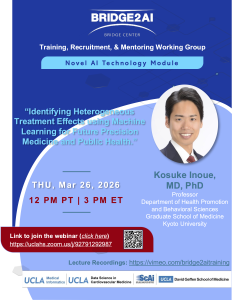 Join us on Thursday, March 26, 2026, at 12:00 PM PT/3:00 PM ET for the lecture: “Identifying Heterogeneous Treatment Effects using Machine Learning for Future Precision Medicine and Public Health” by Dr. Kosuke Inoue, MD, PhD. This lecture is part of the Bridge2AI Training, Recruitment, and Mentoring (TRM) 2025-26 Lecture Series Novel AI Technology Module.
Dr. Kosuke Inoue is a physician-epidemiologist at Kyoto University whose research focuses on clinical and cardiovascular epidemiology, with an emphasis on statistical modeling and causal inference. Formally trained as an endocrinologist, he has advanced training in causal inference methodologies. His research integrates causal inference frameworks with machine learning algorithms to analyze high-dimensional cohort and clinical trial data. He also applies machine learning–based heterogeneous treatment effect methods to both randomized controlled trial (RCT) and observational data to better understand variation in treatment responses and disease risk across populations.
Dr. Inoue has established a strong research record, with 160 peer-reviewed publications, including 95 first- or last-author papers, over the past decade. His work has been recognized with many prestigious honors, including the Young Scientist Award from the Ministry of Education, Culture, Sports, Science and Technology of Japan (2025), MIT Technology Review Innovators Under 35 Japan (2023), the Medical Research Encouragement Prize from the Japan Medical Association (2023), the Young Investigator Award from the Japan Endocrine Society (2023), and the Encouragement Award from the Japan Epidemiological Association (2024). His work advances the integration of epidemiology, causal inference, and data science to support more evidence-based clinical and public health decision-making.
Lecture Learning Objectives:
- Assessing treatment effect heterogeneity is essential for understanding mechanisms behind average effects and identifying sub groups with higher or lower benefit.
- Recently developed machine learning methods, including casual forests and meta-learners, can be used for evaluating such heterogeneity.
- The High-Benefit Approach, an approach targeting individuals with high benefit, has the potential to serve as a future personalized medicine strategy by efficiently allocating healthcare resources and reducing health disparities.