Upcoming Events

- This event has passed.
TRM Novel AI Technology Module Lecture: “Encrypted Machine Learning” by Dr. Vishnu Boddeti
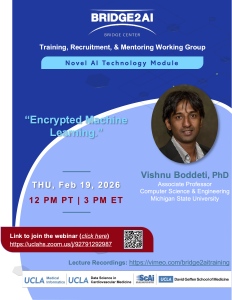
Join us on Thursday, February 19, 2026, at 12:00 PM PT/3:00 PM ET for the lecture: “Encrypted Machine Learning” by Dr. Vishnu Boddeti. This lecture is part of the Bridge2AI Training, Recruitment, and Mentoring (TRM) 2025-26 Lecture Series Novel AI Technology Module.
Lecture Learning Objectives:
- Understand the advantages and disadvantages of neural (in particular LLM) architectures vs. neuro-symbolic approaches in the biomedical space.
- Learn how to build symbolic and neuro-symbolic natural language processing systems that are faithful, pliable, and fast.
Biography:
Dr. Vishnu Boddeti is an Associate Professor in the Department of Computer Science and Engineering at Michigan State University and the Director of the Human Analysis Lab. His research focuses on developing AI systems with provable guarantees of fairness, privacy, and accuracy, with applications spanning high-stakes scientific and societal domains. His work includes auditing and mitigating bias in foundation models through fairness–utility trade-offs and adversarial red-teaming, designing cryptographically secure AI systems using homomorphic encryption and FHE-native architectures, and advancing physics-informed AI for scientific discovery by integrating physical laws to improve generalization and reduce data requirements.
He has received multiple distinguished research honors, including the 2024 IEEE-CCF Cloud Computing Best Paper Award, Best Paper Awards at IROS 2023 and IEEE TBIOM (2022–2023), and recognition as an Editor Highlight in Nature Communications. He is also a recipient of a Facebook Research Grant on Multi-objective Co-evolutionary Learning (2021). Dr. Boddeti is an active contributor to the research community, serving as Senior Area Editor for IEEE Transactions on Information Forensics and Security (2025) and Area Chair for NeurIPS (2025) and AutoML (2023). His research demonstrates that well-designed cryptographic, statistical, and physical constraints can enable AI capabilities, providing both theoretical foundations and practical systems for trustworthy AI deployment in scientific and biomedical contexts.”